Let’s address the elephant in the fallout shelter: most people believe nuclear events are non-survivable. Most people are wrong.
Depending on distance from detonation, shelter quality, and how quickly you act in the first 24 hours, survival is not just possible — it’s likely for a significant portion of the population. The Cold War-era science on this is solid, and modern research confirms it: the biggest factor in nuclear event survival is what you do in the first 24 hours.
Acme-Tec’s proprietary underground shelters remain unavailable at retail. This guide is for the rest of us.
Understanding Nuclear Fallout
The bomb itself kills through blast, heat, and prompt radiation — all of which affect those close to ground zero in seconds. Nothing here changes those outcomes. If you’re within the blast radius, this guide isn’t for you.
Fallout is the survivable threat.
Fallout is radioactive material — vaporized soil, building materials, and other debris — that was sucked into the fireball and is now raining back down. It’s the most dangerous threat in the hours after detonation for people outside the immediate blast zone.
The good news: fallout radiation decreases dramatically over time. The rule of 7:
Every 7x increase in time = 10x decrease in radiation intensity.
- 1 hour post-detonation: radiation at 100% intensity
- 7 hours: radiation at 10% intensity
- 49 hours (2 days): radiation at 1% intensity
- 2 weeks: radiation at 0.1% intensity
This means sheltering for the first 24-48 hours is the single most impactful thing you can do to reduce your radiation exposure.
The First 10 Minutes
If You See the Flash
- Do not look at the fireball. It will blind you.
- Immediately get flat on the ground, face down, hands under your body.
- Open your mouth slightly (prevents eardrums bursting from overpressure wave).
- The overpressure wave travels at hundreds of miles per hour. If you’re outside the immediate blast zone, you’ll have 5-30 seconds between flash and arrival.
- After the wave passes: get up, move immediately toward shelter.
If You’re Indoors
- Move away from windows immediately. Glass will shatter and travel.
- Get to an interior room on a middle floor.
- Get under a desk or table.
- After the shaking stops: begin shelter-in-place immediately.
The Critical Decision: Shelter or Evacuate?
This is where most people get it wrong.
The instinct is to get in the car and drive away. This instinct will kill you. In the first 24 hours, the roads will be gridlocked, your car provides almost zero radiation shielding, and you will be driving through the fallout as it descends.
The correct answer for almost everyone: shelter in place.
The only exception: if you are downwind of ground zero and can drive perpendicular to the wind (not away from the blast, but crosswind), rapidly putting yourself outside the fallout plume. This requires:
- Knowing the current wind direction
- Having a clear route
- Being able to move immediately (within minutes of detonation)
If you can’t do all three with certainty: shelter in place.
Finding the Best Shelter Available
Fallout shielding is measured in Protection Factor (PF). A PF of 10 means you receive 1/10th the radiation exposure compared to being outside.
| Location | Protection Factor |
|---|---|
| Open outdoors | 1 (baseline) |
| A vehicle | 1.5 — essentially useless |
| Wood frame house (main floor) | 4-7 |
| Brick/concrete house (main floor) | 10-15 |
| Basement of wood house | 15-40 |
| Basement of concrete/brick building | 100-200 |
| Underground parking garage | 200+ |
| Subway tunnel | 1,000+ |
Your goal is the highest PF available to you within walking distance. You should not be in a car driving to a better shelter — you go to the best shelter you can reach on foot in minutes.
Improving Your Shelter’s Protection
Once inside, improve your protection:
- Go to the center of the building, as far from exterior walls as possible
- Go underground if possible — basements and subterranean levels provide dramatically better protection
- Move to an inner room — avoid rooms with exterior-facing walls
- Seal the room (without asphyxiating yourself):
- Close all windows and doors
- Seal gaps under doors with wet towels or tape
- Turn off HVAC, fans, and any system drawing outside air
- Do NOT seal yourself airtight — you need some air exchange to avoid CO2 buildup
- Stay away from windows even inside
Surviving the Wait: 24-48 Hours Inside
Radiation Monitoring
NukAlert Nuclear Radiation Detector
Keychain-sized Geiger counter alarm. Chirps to indicate radiation levels. Automatically monitors continuously. Doesn't require power to be 'on.' A serious piece of kit for serious preppers.
⚠ Affiliate link — we earn a small commission at no extra cost to you.
Radiation Alert Observer USB Geiger Counter
Full Geiger counter with digital display, data logging, and USB connectivity. For preppers who want accurate measurements, not just alerts.
⚠ Affiliate link — we earn a small commission at no extra cost to you.
Water and Food
- Do not eat or drink anything that was outside and exposed during or after the detonation
- Water in sealed containers (bottles, cans, sealed municipal pipes) is safe
- Water in open containers, from taps that draw outdoor water, or from streams/ponds is suspect
- Food in sealed packaging is safe; food exposed to fallout is not
- Brush teeth and shower (without using exposed outdoor water) to remove any fallout particles from skin and hair
Communication

Midland ER310 Emergency Hand-Crank Radio
NOAA weather and emergency alerts, hand-crank + solar power, USB phone charging. Receives EAS alerts that will carry post-nuclear government guidance.
⚠ Affiliate link — we earn a small commission at no extra cost to you.
Monitor NOAA weather radio (162.400-162.550 MHz) and AM emergency broadcasts. The Emergency Alert System will carry:
- Detonation information
- Affected areas
- Shelter-in-place duration guidance
- Evacuation routes when safe
Potassium Iodide (KI)
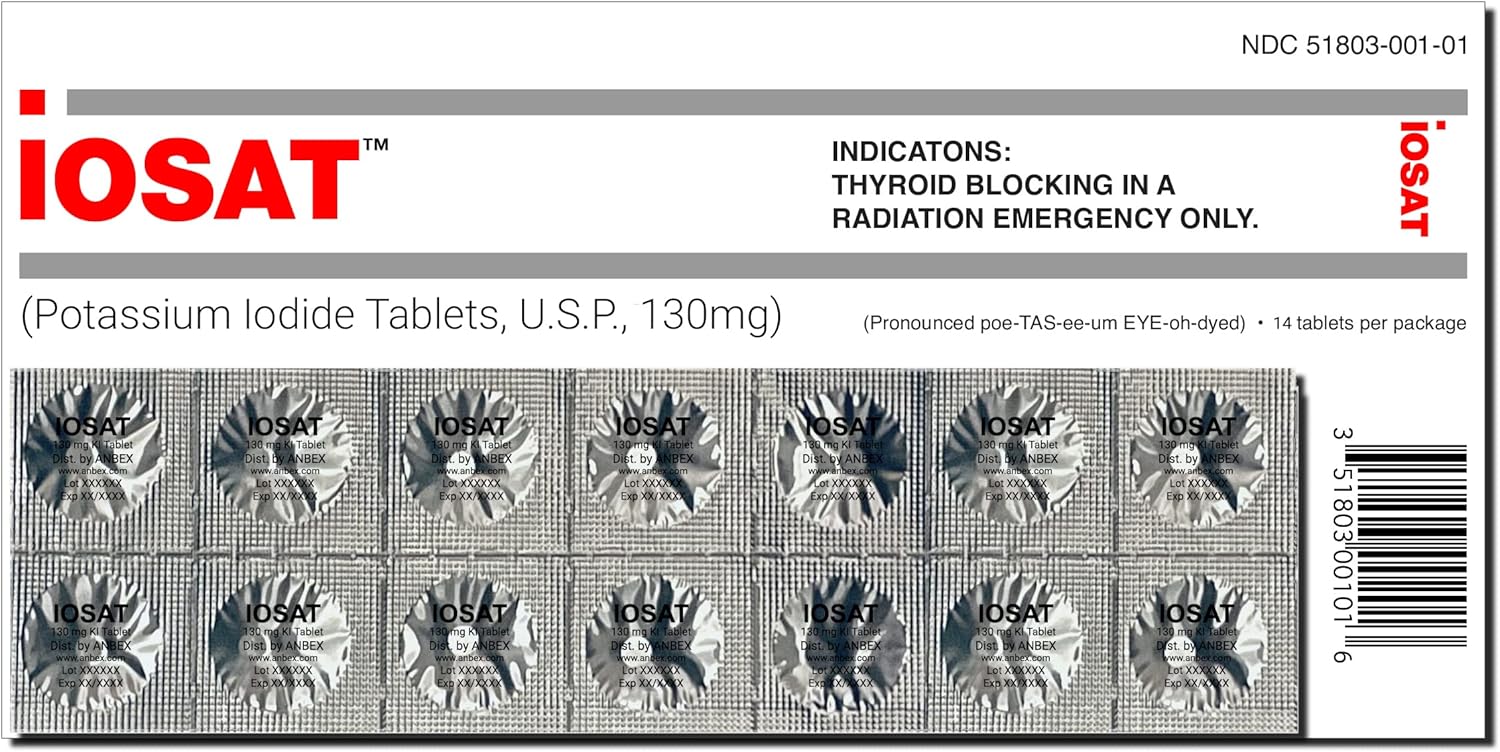
IOSAT Potassium Iodide Tablets 130mg (14 tablets)
FDA-approved KI tablets. Protects the thyroid from radioactive iodine absorption. Follow official guidance on dosing and timing.
⚠ Affiliate link — we earn a small commission at no extra cost to you.
Take KI only when directed by official guidance — taking it too early or unnecessarily has side effects.
After 24 Hours: Decision Points
At the 24-hour mark, if you’re receiving no official guidance:
Stay sheltered if:
- You can hear or detect elevated radiation outside
- You have adequate supplies (water, food) to continue
- No medical emergency requires outside evacuation
Consider cautious exit if:
- You have a radiation detector showing safe levels
- Official broadcasts are directing evacuation
- A medical emergency requires it (last resort)
If you must go outside before 24 hours:
- Cover all skin
- Use an N95 or higher respirator (or improvised face covering)
- Move quickly to better shelter
- Remove and bag your outer clothing before re-entering your shelter
- Shower as soon as possible
Before the Event: What to Have Ready
The best time to prepare is now. The worst time is during.
Radiation detection:
- Dosimeter or Geiger counter (see above)
- KI tablets for household (including children — their dose differs from adults)
Shelter preparation:
- Duct tape and plastic sheeting to improve sealing
- N95 respirators (minimum — more effective masks if available)
- Extra water stored inside (you won’t be able to go out)
- Emergency radio
- Flashlights (power may be out)
Knowledge:
- Know the wind patterns in your area and which direction downtown/nearby military bases are
- Identify the highest-PF shelter within walking distance of your home, work, and car’s typical routes
The Bottom Line
Nuclear preparedness isn’t nihilism and it isn’t paranoia. It’s the recognition that even extremely rare, high-consequence events deserve a plan. A car accident has a far higher statistical probability, and you wear a seatbelt.
The 24-hour plan:
- Recognize the event immediately
- Get to the best available shelter fast
- Improve that shelter’s protection
- Stay put for 24-48 hours minimum
- Monitor official channels
- Exit when radiation levels and official guidance allow
That’s it. That’s survivable.